Wednesday, May 22, 2013

Everglades National Park - Take 2

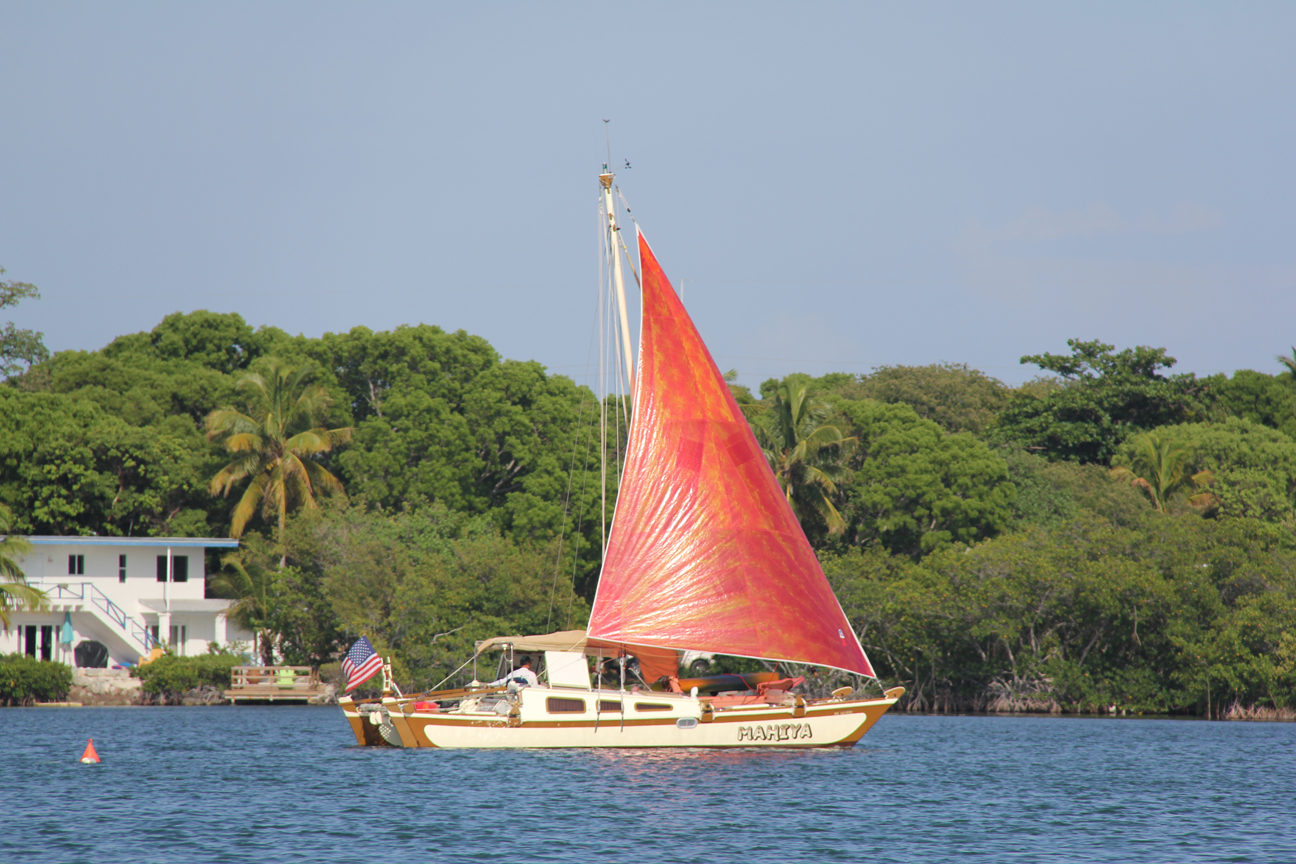
A 10 kt easterly breeze made a leisurely 24 mile beam reach sail from Marathon, Florida to Sandy Key in Florida Bay. The Seawind 24, even loaded, makes 6 to 7 kts in 10 kts of wind - such a pleasure! We were on our way to Whitewater Bay and decided to do just short hops so we get to enjoy the beauty of Florida Bay. There are so many islands, each with its own bird and sea life. Sandy Key has large colonies of various birds and with our shallow draft we can get in fairly close. We anchored in less than 3' of water.
Our bed under the stars off Sandy Key
Day 2 was another 20 something mile day via Little Shark River to Oyster Bay in Whitewater Bay. The wind had increased a bit to 15 kts and was now more southerly. The Seawind is really happy on a broad reach and the water was soon hissing by with a nice wake trailing behind. Sail trim is really important on this boat; a small change can make a difference of a couple of knots.

We saw fewer dolphins this time but a lot more fish and many sea turtles. Before noon we were in the Little Shark River - still more turtles. The river is really beautiful - tall mangrove forests line the banks. The trees totally block the wind so we motored for another hour before reaching Oyster Bay and dropping anchor near the northern end of the bay. Oyster Bay is spectacular; completely enclosed by very tall and very green mangrove forest and dotted with many islands. The water is tea colored but quite clear. Soon after anchoring a pod of dolphins came over and had a good look at us. Maybe they don't see too many boats here; the place seemed deserted to us too. Late in the afternoon a couple of small fishing boats went by some distance away and then we were completely alone until about midday the next day when another fishing boat crossed the other side of the bay.
Oyster Bay

We had not realized that a nearby island was a roosting place for white ibises and in the late afternoon they stated returning in large flocks until thousands of them had settled in the trees. In the morning there was a mass exodus as they left for their feeding grounds. It was an amazing sight to see so many birds in the air at once.

Ibis departing for their feeding grounds
The nights here were just wonderful; we pitched our tent on the forward trampoline and enjoyed the sounds of owls hooting, and fish splashing. Later that night the mosquitoes found us. Lucky our tent has good screens because eventually there were so many it sounded like we were inside a bee hive. They all left before sunrise and we were free to come out and enjoy the dawn colors and the magnificent bird departure spectacle.
Our tent on the trampoline
The next day we explored Whitewater Bay, sailing the open areas and motoring through the passes.  Later that afternoon we positioned ourselves for a better view of the ibis return and departure that night and following morning. It was as expected, just awesome!
We had planned to stay a couple more days but the forecast was for a day of northerly breezes and then 5 days of strong southerlies. Not wanting to beat into 20+ kts and against the current we decided to run with the northerly. A smooth sail south to East Cape Canal for another quick photo session with the crocs. There were fewer crocodiles this time and they were really shy.
One of the East Cape Canal crocs

Some baby herons along East Cape Canal
We spent the night there and then sailed to Flamingo for showers and water before heading to Islamorada via several passes and islands for the annual Wharram Rendezvous.

We had read about the Wharram rendezvous and thought it might be interesting. It is good to see a design of boat that is built in so many different styles. There were only six boats at the rendezvous but they were all unique and really reflected the owners' characters.
This was the best looking one in my opinion
A local wharram
This one had a windvane self steering

 
Next: Sailing Southern Florida Bay and the Keys..........
 

Wednesday, May 1, 2013

Some info about the boats we have owned

Our current boat as you know is a Seawind 24. It was built in Australia in 1982/83 and imported into the USA. It is hull #230 and was bought as a sample boat for a proposed business to sell Seawinds in the US. The project, however, never got off the ground. Seawind 24's were later built under license in Florida USA. Specs for the boat can be found at http://www.seawindcats.com/index.pl?page=43

We owned one other sailboat, a 35' catamaran, which we built from HDB in Richards Bay, South Africa. It was also Australian, designed by Jeff Schionning. http://www.schionningdesigns.com.au/ We lived aboard this boat for almost 4 years during construction and another year on the water before we sold her. I have included a slide show of the boat from receipt of the hull to the final sale of the boat. She was a lovely boat and an absolute pleasure to sail. Unfortunately we had to sell her when we decided to move to the US. Her name was "eezikapeezi".


eezikapeezi

Tuesday, April 30, 2013

Flamingo, Florida Bay, Islamorada, and back to Marathon

Our departure from East Cape Canal was a bit hairy! The canal is deep enough, 10'+, but there is a bar across the exit into the sea and the water is very brown. The depth went from 10' to 2' in a short distance, I saw 1.1' flash on the depth sounder and the rudders kicked up but we did not touch the bottom even though it was quite choppy. Once across the bar it was plain sailing once more. The wind was a good 15kts from the north and we quickly picked up speeds exceeding 10kts. This made for a short trip and we were soon tied up at one of Flamingo's docks. They do not charge if you are only staying for a few hours so we had showers, filled up with water and headed out again. An interesting rowboat followed us in; they had just come from Fort Myers FL and were doing some sort of trials in preparation for a circumnavigation.

Ocean going rowboat
Huge flocks of shore birds and white pelicans were feeding on the sandbanks outside the Flamingo Marina as we navigated the channel out. There can be strong cross currents here and one needs to pay careful attention as there is very shallow water on both sides of the channel. From here we made our way south through some quite narrow passes near Murray Key and on to Man-o war Key where we anchored for the night. The water was really clear over sea grass but there didn't seem to be any fish around at all, even the ever present dolphins were nowhere to be seen. Lots of birds though, the island was full of cormorants.

Not the best photo but this is one of many flocks of cormorants leaving Man-o-war Key in the morning.
 Next we sailed on to Rabbit Keys for a night, still clear water and still no fish. I was expecting to see quite a lot of sea life here so this seemed a little strange. Sharon baked a delicious loaf of corn bread in the solar oven while we were sailing today.

Corn bread baked in our solar oven
 
The next morning we sailed to Islamorada to get online again and start processing some of the photos. We anchored off the Lorelei Bar and Restaurant which gets quite lively at night, a big change from the quiet in the Everglades..... good music though.

At 4 am one morning while at anchor during a rain storm, I was just thinking how dry and cosy our little Seawind 24 was when a big squall hit us followed by much wailing of the anchor drag alarm. We scrambled onto the deck in blinding rain and major lightning. By the time we got the engine started and the anchor up we had dragged 1/3 mile between some other boats (also dragging). We headed for the shallow water near some mangroves for some protection and managed to anchor again. We kept the engine in gear to help keep pressure off the anchor as the wind was still blowing in excess of 50kts and the holding here was less than perfect.

I still had a lot of photo editing to do and we had come up with some mods we wanted to do on the boat so we decided to sail back to Marathon City Marina to spend a month on a mooring ball before heading back to the Everglades. A nice downwind sail from Islamorada to the Seven Mile Bridge, managed 8.5kts with the genoa alone. This boat sails so nice!

Next: Trip 2 to the Everglades, White Water Bay.....

Wednesday, April 17, 2013

On To The Everglades


We began the first leg of our Florida Everglades photography adventure by defying superstition on a Friday morning with loads of bananas! A Seawind 24 does not carry much weight so 3 weeks worth of food and 1 week of water plus all our belongings had her right down on the her waterline. She felt a bit sluggish, which we expected, as we headed out of Boot Key Harbor. We were escorted out by a fairly large pod of dolphins followed by a couple of manatees who disappeared into the slightly murky water as we approached. Turning north in a 10 to 15 kt SE wind we were soon sailing along at 6 to 8 kts even with our big load. Our first destination was Sandy and Carl Ross Keys, a nesting area for roseate spoonbills. We arrived at about 2 pm and anchored in 2’ (we just love this shallow draft) of beautiful clear water.  The wind was light and the islands just beautiful, not another person/boat in sight, just peace and quiet, and lots of birds; spoonbills, pelicans, cormorants and white herons.
Sunrise over Carl Ross Key, Florida Everglades
Day 2 was supposed to be a short leg up to the west entrance to Lake Ingraham but did not work out quite as expected. When we arrived at the entrance the tide was going out and the current was really strong. We had planned to enter and anchor near the north west end of the lake but with the strong current and deep (10 to 15’) water we decided to head further into the lake. The channel became narrow with extremely shallow water on either side and with strong wind the only option was to carry on through the lake to East Cape Canal. We found a nice place to tie up near the canal dam. We saw a lot of dolphins along the way and in Lake Ingraham. Once we were tied up we sat on the trampoline enjoying the great peace in the Everglades while we had a wonderful meal which included fresh bread baked in the solar oven while we were sailing.
Our dingy with "Homerun" in the background at East Cape Canal
Owls and crickets are about the only sounds heard during the night in the Everglades. We saw the occasional firefly but not much else. Having coffee and breakfast in on the tramp in the morning was pretty special in such beautiful surroundings. We saw an American crocodiles near our boat which was quite exciting as this was one of the animals I had come to photograph. He drifted over to have a look at us and then went back to where we first saw him. The day was hot and humid which we expected ahead of the approaching cold front. Later the bugs came out; no-see-ums in a cloud that has to be seen to be believed. They kept us pinned down in the boat all night and most of the next morning until the wind came up. We did manage during the night (with lots of bites) to run out and take a quick shower in the rain and collect a fair amount of drinking water in our water collection system.
This american crocodile was about 30' from our boat at East Cape Canal
The next day we rowed our dinghy up the East Cape Canal to the north of the dam. We saw lots of crocodiles, 50+, they were on every sand bank and they had spots along the canal bank where they were basking. One came up right next to us, gave himself (and us) a big fright! They have the most beautiful yellow eyes, kind of like a cat’s eye just much bigger. We also saw lots of birds, including spoonbills, pelicans, Caspian terns, cormorants, herons, and a kingfisher being chased by a merlin. I got shot of photographs which will be posted on my website at; http://www.alanbosse.com/Photography.html We repeated this dinghy trip the following day and saw mostly the same crocs and birds.
Next: Flamingo FL for showers and water…….

Monday, March 4, 2013

The Everglades Adventure

As we continue to make Homerun liveable, we are also preparing for a 2 to 3 week trip to the Florida Everglades to do some nature photography. We were planning to depart between the end of February but the weather is holding at this stage. The wind has been blowing out of the north for a number of days now and as soon as it changes to anything other than the north we will be off. We will be stopping off at Lake Ingraham and then plan to concentrate on an area called Whitewater Bay.

Loading the boat with 3 weeks worth of food and water takes some planning as it is really easy to overload a catamaran and make it sluggish at best and dangerous in rough water. One thing we are doing in our Seawind 24 to keep the weight down is installing lightweight net hammocks for stowage instead of shelves or other heavier wood structures. The hammocks allow airflow to prevent mildew, and nothing falls out while sailing. We made them with leftover net from our trampoline.

Net hammock for storage aboard our Seawind 24
  I was asked to elaborate a bit on our electrical system. It was non-existent when we arrived here at Boot Key Harbor and so we had to design it from scratch. We want to keep the boat simple with as little maintenance as possible and this goes for the electrical as well. So far we only have power in the right hull which is used for our computers, a depth sounder, and for charging batteries for our various electronic devices, and our nav lights. The nav lights are portable LED lights and mostly stowed away as we do not intend sailing much at night. They are lightweight and should they be needed the batteries last 3+ days continuously so nothing to worry about there. In the left hull we have two portable lights one of which is solar charged directly and the other has rechargeable batteries - all LED. The whole system is charged by a 30 watt solar panel and stored in a 79 amp/hr battery.

The electrical panel - 7 amp controller, 400 watt inverter, & 2 12v outlets.
 
Next: The first leg of the Everglades Adventure............


Sunday, February 10, 2013

The Next Phase

Now that we are all moved in and situated in Marathon Florida, it is time to get the boat setup for sailing and daily living. Up to now we have only concentrated on getting the boat to Florida and into the water. Before we bought the boat it had not been sailed since about 1985 and nothing was properly rigged. We have a 20 something year old set of sails still in the bags, never used in perfect condition as well as a slightly used set. All the deck hardware is on the boat and all running rigging is still in excellent condition. We did a few sea trials to get used to the boat, sort the rigging and sails out, and also to decide if we wanted to change anything.

The boat really sails nice and we easily reached 7kts in less than 10kts of wind with just the main. The topping lift was missing which made it a mission to get the main onto the boom and we also decided some lazy jacks would be a good idea. This meant lowering the mast once again. The mast lowering procedure is fairly simple but does need still water so we motored up a local mangrove creek to find a quiet place with no dinghies going by. We fitted the topping lift and lazy jacks using our dinghy and got the mast back up in a couple of hours with no problems.

Lowering the mast in the Boot Key mangroves
 Some other mods we needed to make was to fit a composting toilet and an electrical system:

Fitting the toilet, a Nature's Head, was really easy. We just stuck it to the floor in the starboard hull and fitted a Nicro solar powered vent with batteries which runs day and night. The toilet works great and is easy to empty.

Our Nicro solar powered vent for the toilet
 
The electrical system is very basic; we only need to operate 2 computers, one small laptop for navigation and watching movies, a larger laptop for running my graphic design and photography business (Alan Bosse Graphic Design), the Garmin Echo 100 depth sounder, and for keeping our cordless tools and nav equipment charged. We fitted one 79Ah battery and a single 30 Watt Sunforce solar panel. This is working fine so far running the main computer 4 to 5 hrs/day 3 days/week but we will add another panel if necessary. Our lighting is from separate, solar charged, individual lamps.

Cooking was another area we want to address. We are trying to reduce our environmental footprint as much as possible and felt we needed to get away from gas as much as we could so we went with a Sport model solar oven from the Solar Oven Society. This oven is just amazing; we have made several delicious meals and even baked bread and chocolate cake. We still use gas to heat water for tea but we will still get organized enough to do this with solar.

Next: Preparing for the Everglades Adventure...........

Wednesday, January 23, 2013

Moving Aboard

Now that we had the boat in the water, it was time to try cram all our stuff in and still have place to sleep. At first it looked hopeless but after a few visits to The Salvation Army and the local homeless kitty charity we got our stuff down to somewhat manageable proportions. We spent the first few nights in our tent on the main trampoline while we got things organized inside.

The left hand forward bunk was described in an article about the boat as being a double bunk. It is about 2/3 the width of a single bed! We are both pretty skinny so we fit ok and as we get things organized life is getting more comfortable.

With all our remaining possessions either stowed or donated it was time to depart Bahia Honda and head over to The Marathon City Marina. The weather wasn't the best but a stiff westerly wind was in our favor and we set off. We had to motor out of the marina against strong wind and really choppy sea initially and immediately started having engine trouble. We'll save the rest of that tale for the next blog but we got back to our dock at Bahia Honda and the engine fired up and ran ok again. I think the problem was related to an EPA required valve attached to the new fuel tank. We had a long discussion on the engine and decided to ditch the old 2 stroke in favor of a new 4 stroke as having engine trouble in this area with the strong tidal currents and many hazards could be disastrous.

West Marine ordered the engine and we had to wait a week for that. Once installed and working we were once again ready to depart. The weather turned nasty and another 10 days went by before the small craft advisory was lifted and we finally escaped the Bahia Honda State Park. The trip was choppy and wet but the warm water, 77F, was actually quite pleasant. We arrived 3 hours later at The City Marina thus completing the "marathon to Marathon".


Sunrise at Boot Key Harbor mooring field


A pelican flying by our boat

The Marathon City Marina is well organized and the facilities and amenities are really good and clean. The moorings are in excellent condition and we feel safe leaving our boat and going away for the day. They have a rule that all boats must be lived aboard and no wet storage is allowed. This makes a pleasant change from all the places that don't allow liveaboards. Our little boat is of course dwarfed by all the large and expensive boats around here.


Us going out for a sail

Most people can't believe that we actually live on the boat. It does look really small and narrow but there is more space inside than it seems from the outside.


This has got to be the worst boat name ever!
 

A young pelican took a break on our boat
 
Next, life in a small boat begins to take shape...........